Published November 2, 2026
Buying a Condo in Portland, Oregon: The Real Pros, Cons, and What the Numbers Actually Tell You

Buying a Condo in Portland, Oregon: The Real Pros, Cons, and What the Numbers Actually Tell You
There is a version of Portland condo ownership that sounds incredibly appealing: walk to Powell’s, watch the river from your balcony, never rake leaves again! As someone who hates raking leaves and doing yardwork, it is a really compelling pitch.
For a lot of people, it is completely true.
But there is another version of condo ownership that does not come up as often, and it involves HOA fees that have climbed 13% in a single year, a condo appreciation track record that looks quite different from what single-family homes have delivered over time, and a lending environment that can throw a wrench in the system and complicate your financing depending on which building you choose.
None of that means condos are a bad idea or aren’t worth pursuing, instead it means that going in with clear eyes gives you a real advantage, whether you are buying your first place in a new city, relocating here from the Bay Area, or sitting on a condo you have owned for a few years and wondering what to do with it.
This blog lays out the full picture.
Highlights (The Numbers)
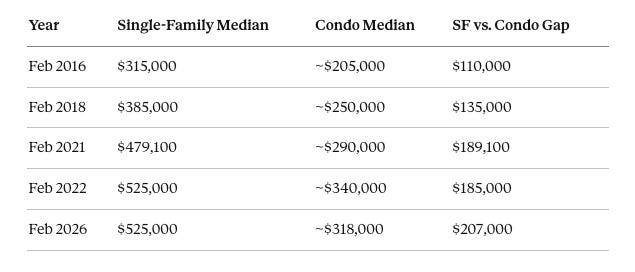
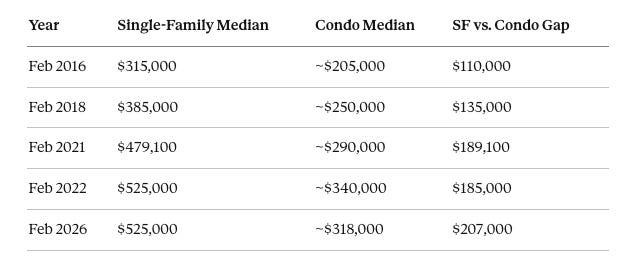
- Portland condo median sale price is running approximately $318,000 as of early 2026, per RMLS (our local Multiple Listing Service), compared to $525,000 for single-family homes. That gap has widened from $110,000 in 2016 to over $207,000 today.
- Over the past ten years, using RMLS data from February 2016 to February 2026, single-family homes gained roughly $210,000 in median value (67%). Condos gained roughly $113,000 (55%). After accounting for HOA fees, the real return gap is wider than those numbers suggest.
- The condo market softened after peaking around $340,000 in early 2022. The Multnomah County condo median fell 10% from that peak by 2025, and was down an additional 6% year-over-year from 2024 to 2025, per RMLS data cited by OregonLive.
- HOA fees in Portland’s urban condo buildings typically run $300 to $600 per month. Luxury towers in the Pearl District and South Waterfront can exceed $900 per month. Regional dues rose approximately 13% in 2025 alone.
- For the right buyer, condos offer lifestyle advantages that should be weighed alongside the financial trade-offs to find out if condo ownership is right for your circumstances.
How Condos Differ From a Traditional Home Purchase
Before getting into the pros and cons, it helps to understand what you are actually buying when you purchase a condo, because it is different from buying a house.
When you buy a single-family home, you own the structure and the land it sits on. Maintenance, repairs, insurance, and any improvements are your call and yours alone (for the most part).
When you buy a condo, you own the interior of your unit, typically from the interior walls inward, and a proportional share of everything else in the building. The hallways, the roof, the elevators, the utility room, the parking structure, the lobby: you own a piece of all of it, alongside every other unit owner. That shared ownership is managed by a Home Owners Association (HOA), which collects monthly dues, maintains reserves for future repairs, and sets the rules for how the building operates. Essentially, you’re getting into business with your neighbors in the form of an HOA.
You pay for the building whether you use it or not. If the roof needs replacing, the HOA assesses all owners. If the master insurance policy doubles, your dues go up. You do not get to opt out of building expenses because you are on the third floor and never use the rooftop deck.
Your financing depends on the building, not just your creditworthiness. Lenders evaluate condos differently than houses. For conventional loans backed by Fannie Mae or Freddie Mac, the building itself has to meet certain standards around owner-occupancy rates, delinquency ratios, and reserve funding. FHA loans have their own approval requirements. If your building does not qualify, your pool of eligible buyers shrinks, which matters both when you are buying and when it is time to sell.
You have neighbors in a way that single-family homeowners do not. The person above you, below you, and on both sides of you are part of your daily life in a way that does not happen in a detached home. For some owners, that is a dealbreaker while for others, it is a feature.
The Portland Condo Market in 2026: Where Things Stand
The Portland condo market came into 2026 in a softer position than the broader housing market. According to the RMLS Market Action Report for February 2026, the Portland Metro median sale price for all residential properties was $525,000. The condo-specific median, also tracked by RMLS, has been running in the $315,000 to $320,000 range through early 2026.
The RMLS data also shows a stark picture in active and closed condos (think of “active” as being on the market currently and “closed” as sold). Active condo listings have climbed substantially since 2023 while closed sales have remained essentially flat. Those two paths diverging is the visual definition of a buyer’s market. You’ve got more supply with the same demand and that equals slower sales.
Total market time across all Portland Metro residential properties hit 91 days in February 2026. For condos specifically, the Portland Appraisal Blog’s 2025 annual review, which also draws from RMLS, puts average condo days on market at 102 days, with cumulative days on market up 32% year-over-year. HOA dues across the region rose approximately 13% in 2025 alone.
The gap between the median condo price and the single-family median price is worth sitting with. At roughly $315,000 to $320,000 for condos versus $525,000 for single-family homes, you are looking at a difference of about $200,000 in purchase price. That is real money in down payment, monthly payment, and financing costs.
Not all Portland condo submarkets are experiencing this difference equally. Neighborhood-level RMLS data pulled directly from the MLS shows the variation is significant:
*February 2026 SW Portland figure based on 4 closed sales, one of which was 1.2million so skewed the other three.
The Pearl is operating in a completely different league from every other submarket. The remaining three are elevated but functioning. Knowing which market you are in changes the strategy entirely.
The Pearl District
The Pearl District is Portland’s most recognizable urban condo neighborhood, 120 city blocks north of downtown bounded by West Burnside to the south and the Willamette River to the north. It is generally considered very walkable, with a Walk Score of 97. You’ve got Powell’s City of Books, multiple parks, the Portland Streetcar, and more restaurants per block than most cities manage per neighborhood. You also have a concentration of homelessness spilling over from Oldtown and taking up residence near county, city, and non-profit services nearby.
The numbers from a 72-month report for 97209, pulled directly from the MLS, tell a real story about where the Pearl stands today.
Over the full six-year period from March 2020 through February 2026, 1,750 condos sold in the Pearl District at a median sold price of $389,000 and an average of $430,540 while the current picture is considerably softer.
In February 2026, only 14 condos closed in the Pearl. The median sold price was $258,325 while the average cumulative days on market was 250 days, with a median of 246 days. There are currently 161 active condo listings competing for a buyer pool that is buying roughly 24 units per month, which equals about 6.5 months of inventory. Look at it this way, if you were a buyer, you’d have over 6 months of condos to look at if no new condos came on the market before they all sold. That is solidly in the buyers favor.
To put that in perspective: in early 2022 during the height of the COVID real estate push, Pearl District condos were selling with average days on market under 70 and inventory below one month. The market has moved from one extreme to the other.
The inventory ranges from $195,000 for smaller studios to $2.9 million for top-floor units in buildings like The Metropolitan and Waterfront Pearl. That price spread means buyers have many options across a wide range of budgets, and sellers are competing against a substantial pool of active listings so if you’re selling you have to stand out in some way (condition, views, marketing, amenities, concessions, price, or all of those!)
Close-In Southeast Portland
Southeast Portland’s close-in condo market, covering roughly Buckman, Hosford-Abernethy, Ladd’s Addition, and Sunnyside neighborhoods tell a noticeably different story from the Pearl District.
Over the same 72-month period, 748 condos sold in close-in SE at a median price of $400,000 and an average of $444,195. The six-year median is actually $11,000 higher than the Pearl despite the Pearl’s reputation as the premium urban market. I strongly believe that reflects the Pearl’s oversupply problem more than it reflects any premium on SE prices.
The current conditions make the contrast even sharper. In February 2026, SE Portland condos averaged 120 cumulative days on market compared to 250 days in the Pearl. Active inventory sits at 38 units compared to 161. Months of supply is 3.7 compared to 6.6. The February 2026 median sold price of $339,950 is $81,625 higher than the Pearl’s $258,325 for the same month.
SE Portland condos are genuinely smaller, less “glamorous” market than the Pearl. The buildings tend to be smaller, the amenity packages more modest (way less concierges, gyms on site, etc.), while the day to day experience feels like more of a neighborhood than an urban core. But for buyers who want Portland condo ownership without stepping into the Pearl’s challenges, close-in SE is worth a serious look. The data suggests sellers are finding better outcomes there right now (while buyers may look more favorably on being out of the Pearl’s limelight)
South Waterfront and Close-In SW Portland
The reporting for South Waterfront covers more ground than just the towers alongside the Willamette River. It includes Johns Landing, Corbett, and goes up into Hillsdale and parts of the SW hills. That mix of neighborhood types is worth keeping in mind when reading the data.
Over 72 months, 634 condos sold in 97239 at a median price of $396,250 and an average of $448,233. At 8.8 sales per month, this is the thinnest-volume market in the reporting I looked at, which means monthly medians can swing considerably based on a handful of transactions. The maximum sold price of $999,999 reflects the presence of luxury high-rise units that do not really exist (with a few exceptions) in the suburban or close-in SE markets.
Current conditions show 35 active listings and 4.0 months of inventory. February 2026 produced only 4 closed sales at a median of $319,000, with average cumulative days on market of around 120 days.
What the history shows when compared to all the reporting is interesting (in my nerdy eyes): this market never really compressed as dramatically as the Pearl during the 2021–2022 frenzy. Days on market stayed in the 50–90 day range even at peak demand, suggesting the buyer pool for close-in SW condos was always more selective and less frantic than the Pearl’s. It has since extended into the 112–190 day range in 2025 and early 2026.
South Waterfront buildings like Atwater Place and John Ross carry HOA fees on the higher end of the Portland spectrum. Atwater Place, for example, carries average monthly fees around $903, with a range that stretches from $745 to over $1,800 depending on the unit. Those fees typically cover water, sewer, garbage, building insurance, concierge, and building maintenance, which changes the cost comparison against single-family ownership meaningfully. Those higher HOA fees may have insulated it from the price jumps seen elsewhere.
The Suburbs: SW Portland, Beaverton, and Tigard
Just for a change of pace, I looked at a part of the suburban condo market too. Generally covering Tigard, Beaverton, and outer SW Portland, you’ll find a really different style condo with smaller buildings, no concierge, no rooftop deck, and only rarely steps from the hippest bar or restaurant. On the other hand, what you get instead is probably the most accessible price point in the Portland Metro area and market conditions that are considerably more balanced than the urban core when we’re talking about condos without going to the far east side.
Over the same 72-month period, 1,237 suburban condos sold at a median price of $277,000 and an average of $283,208. The maximum sold price in the entire reporting is $639,000, which shows you this is not a luxury market. It is an ownership market for buyers who need a lower entry price and are willing to trade urban amenities for affordability.
Current conditions show 58 active listings, 3.4 months of inventory, and an average of 17.2 sales per month. In February 2026 the median sold price was $201,375 with an average Days On Market of 112 days.
What the price trend data shows across six years is also notable: suburban condo prices traded in a relatively tight band of roughly $200,000 to $350,000 throughout the entire period. They did not spike as dramatically as urban condos during the 2021–2022 frenzy, and they have not fallen as hard since. The stability, while modest, reflects a buyer pool that is more driven by affordability than by lifestyle enthusiasm, which tends to produce less volatile pricing swings.
For buyers relocating to Portland with a budget under $280,000, this is often where ownership becomes possible. For buyers comparing this market to renting in the suburbs, the math can look compelling when mortgage payments approach rental rates.
Why the “Doubling” Dynamic Does Not Apply the Same Way to Condos
In a previous post, How Long Does It Take for Portland Home Values to Double?, we walked through almost 50 years of data on Portland single-family appreciation. The short version: Portland houses have doubled in value approximately every 12 to 13 years. Nearly every buyer who purchased a single-family home in Portland over those 50 years and held it for 10 to 15 years came out ahead. But, that track record does not transfer automatically to condos.
What Ten Years of RMLS Data Shows
The RMLS Market Action Reports are the most authoritative source of residential sales data in the Portland market. RMLS is the Multiple Listing Service that tracks virtually every sale in the metro, and it publishes median condo prices separately from single-family prices. Using the February report from each year gives us a consistent look at how both asset types have performed over time in comparison to each other.
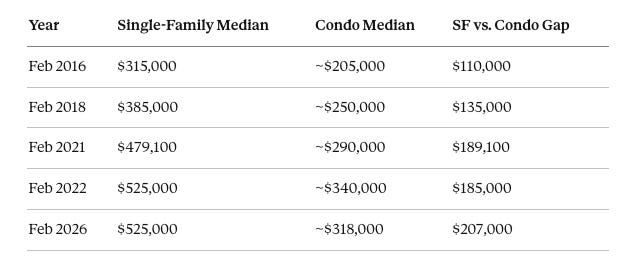
A few things stand out from this table.
Both asset types gained value. Condos went from roughly $205,000 to $318,000 over ten years, a gain of about $113,000 or 55%. Single-family homes went from $315,000 to $525,000, a gain of $210,000 or 67%. Both appreciated. But the dollar gap between them widened from $110,000 in 2016 to over $207,000 today. This was probably the biggest single surprise to me, since I’m seeing some condos (in fairness, these are often in heaviest impact areas near the Pearl and close-in SW) selling for the same prices as they were a decade ago. But the data shows a different story across the whole metro area.
The pandemic years were the anomaly. Both markets ran hard from 2020 through early 2022. Single-family homes kept climbing. Condos peaked around $340,000 in early 2022 and have since pulled back. According to RMLS data cited by OregonLive, the Multnomah County condo median fell 10% from its 2022 peak to $300,000 by 2025, and dropped a further 6% year-over-year from 2024 to 2025. That means condo owners who bought at the 2022 peak are currently sitting below their purchase price in median terms, while single-family buyers from the same period have held their value or gained.
The 2026 single-family median is exactly where it was in February 2022. Prices ran up fast and have since stabilized at that level but, I believe Feb. 2026 numbers are an outlier for single family homes and expect to see us rebound back into the mid-$550s for median prices where we were just a few months ago. For condos, the story is different: prices peaked and then declined. The gap between the two asset types is now the widest it has been seen in the last 10 years.
What this means in practice. A condo buyer in 2016 gained roughly $113,000 in value over ten years. Of course that’s before accounting for HOA fees of even $400 per month. That buyer at $400/mo in dues paid $48,000 over that period and many homeowners did not have $48,000 in repairs over that same time period (although it would be interesting to look at utility costs). A single-family buyer in the same year gained $210,000 with no HOA fees. The wealth-building gap is considerably larger than the appreciation numbers alone suggest.
Land Is the Appreciating Asset
When a house increases in value over time, a significant portion of that appreciation comes from the land underneath it which is finite, at least in our area. The Urban Growth Boundary, administered by the Oregon Department of Land Conservation and Development, limits how far the metro area can expand outward and that institutional governer on land supply is one of the core reasons Portland single-family values have trended upward over decades.
A condo owner does not own land. You own a unit inside a building on land that belongs to the association. The structural supply constraint that drives long-term single-family appreciation does not apply in the same way.
HOA Fees Affect Your Real Return
Even when a condo does appreciate in nominal value, your actual return has to account for the HOA fees paid over the holding period. If you own a condo for ten years and pay $500 per month in HOA dues, that is $60,000 out of pocket before you count maintenance assessments, property taxes, or mortgage interest. That money does not build equity. A single-family homeowner paying a mortgage builds equity with every payment. A condo owner paying HOA dues does not.
Run the math on that $113,000 nominal gain: subtract $60,000 in HOA dues at a modest $500 per month over ten years, and your net gain looks a lot more like $53,000 before any other costs. The same exercise on the single-family gain of $210,000 with no HOA leaves you in a considerably different position.
This is not an argument against condos. It is an argument for understanding what your money is actually doing when you own one.
The Pros of Owning a Condo in Portland
None of the above is meant to scare you off condos. There are genuine, meaningful reasons people choose them. Here is where condos actually win.
Lower Entry Price in a Tight Market
At a regional median price of around $318,000, Portland condos offer a path to homeownership that single-family homes at $525,000 simply cannot match for a lot of buyers. For someone relocating to Portland on a $90,000 to $120,000 household income, the condo market is often where ownership becomes financially possible.
That said, the rent-versus-own calculation deserves math rather than assumption. The comparison between renting and owning is not a slam dunk for everyone to buy, in every case. The smart exercise is to calculate your all-in monthly cost of owning including mortgage payment, HOA dues, insurance, and property taxes and compare it directly to what renting a comparable unit would cost. Rents have been rising over time while owning freezes most of your monthly costs. Ownership also builds equity through paying down principal with every mortgage payment. There’s an old adage that you’re either paying your mortgage or your landlords.
The case for buying a condo today is not really an appreciation story, although that should happen over time. Instead it is a cost-stability and equity-building story along with lifestyle wins. If that math works in your situation, the buying market is favorable. Condos are frequently selling below list price, and buyers have time to negotiate and complete proper due diligence in a way that was harder to do in 2021.
Lifestyle and Maintenance Wins
These are the real winners for condos for most happy owners. When the roof leaks on a house, you have to track down a contractor (or three), get bids, argue about timing, and write a check. When the roof leaks on your condo building, you call the HOA. The repair happens. You do not manage it (you still have to pay for it, but you don’t have to manage the process)
For people with demanding jobs, significant travel schedules, or no interest in home maintenance, that shift in responsibility is worth a lot. The HOA fees are, in part, paying for that peace of mind.
Lock and Leave
Condos are the hands down winners here…you get to close the door, set the alarm (or not), and go. No house sitters needed, no lawn to arrange care for, no pipes to winterize, etc. You just turn the key and go. This matters for frequent travelers, residents and nurses and others who work 12+ hour days, remote workers who move around, and anyone who has ever had a vacation derailed by a home emergency.
Location, Walkability, and Access
Pearl District condos sit a few blocks from Powell’s, the Portland Streetcar, and some of the best restaurants in the city. South Waterfront condos put you on the Willamette River trail within minutes while NW condos give you front door access to Forest Park. These are real wins for lifestyle, both in daily quality of life and in the kinds of things you stop spending money on, like a second car or frequent Uber rides across town.
Amenities You Would Never Build Yourself
Many condos have amenities most of us wouldn’t necessarily put all into our own homes: rooftop decks with views of Mount Hood and the river, concierge services (I’d love to have a home concierge), secure parking, gyms, ddog runs, and more. Some of these amenities exist in Portland condo buildings that would cost extravagant sums to replicate on your own. For buyers who actually use them, the HOA fees start looking like a reasonable membership to something you could not otherwise access.
The Right Fit for the Right Chapter of Life
Here’s the deal, condos are not for everyone at every stage of life but they don’t need to be. For a couple in their 30s or 40s who wants to be in the city without the work of a house, they are excellent. For a retiree downsizing from a large home whose kids have left, they can be liberating. For a professional in the busiest stretch of their career they can make complete sense.
The lifestyle argument for condos is not that condo living is better than house living. It is that for specific people at specific moments, condos may be a significantly better fit, and that fit has real value that does not show up in an appreciation spreadsheet.
The Cons of Owning a Condo in Portland
HOA Fees Are Real and Rising
This is the number that surprises buyers most consistently. According to the Portland Appraisal Blog, average HOA dues across the region rose 13% in 2025 alone, driven largely by master insurance premiums that have spiked nationwide. The 2021 collapse of the Surfside condominium in Florida accelerated a nationwide reassessment of condo building insurance requirements and our buildings have not been exempt from those premium increases. Older buildings, particularly those constructed in the 1990s and early 2000s, are hitting the age at which major capital expenditures become necessary: roofs, plumbing systems, elevators, siding.
High-rise condos in the Pearl District and South Waterfront typically carry fees in the $400 to $900 per month range, and in some cases well above that. You need to factor this number into your monthly payment calculation before you ever look at a listing price.
A useful rule of thumb: add your expected HOA dues to your estimated mortgage payment, and compare that combined number to what a comparable single-family mortgage would cost. That is your real apples-to-apples comparison.
Special Assessments Are a Wild Card (and a Given)
Even buildings with well-funded reserves can hit unexpected costs. When the reserves fall short, the HOA levies a special assessment: a one-time charge to all unit owners to cover the gap. These can range from a few thousand dollars to tens of thousands for each unit owner. Before buying any condo, request the HOA financial documents and reserve study. This is not optional due diligence and needs to be accounted for. Realistically, most condos just had an assessment, are working through an assessment now, or have one coming soon.
Appreciation Is Slower and Less Reliable
As discussed above, Portland condos have not historically tracked the same appreciation curve as single-family homes. For buyers whose primary goal is wealth building through real estate, this matters. A condo can still be a good financial decision, but the math is different, and it deserves honest scrutiny before you commit.
Financing Can Be Complicated
Not every condo building qualifies for conventional Fannie Mae or FHA financing. Buildings with high investor ownership ratios, underfunded reserves, active litigation, or other structural issues can be flagged as non-warrantable, which limits your financing options (read that as, getting a loan is going to be more expensive). When it is time to sell, the same limitation applies to your buyer pool. This is a brief mention here, but it warrants a dedicated conversation with your lender early in the process, not after you are under contract.
You Share Decision-Making With Your Neighbors
HOA governance ranges from smoothly run to genuinely chaotic depending on the building, board, management company (or lack of one), and more. Rules about rentals, renovations, pets, and parking are set collectively and can change. Before buying, attend an HOA meeting or at minimum review recent meeting minutes. The financial documents matter, but so does the tone of how the community operates.
What Condo Sellers Should Know Right Now
If you own a Portland condo and are thinking about selling, the 2026 market requires a realistic read.
In February 2026, the Pearl District (ZIP 97209) saw 14 closed condo sales. Cumulative days on market averaged 250 days. There are 161 active listings competing for a buyer pool absorbing roughly 24 units per month. That is 6.6 months of inventory in a segment where less than three months would indicate balance.
Compare that to February 2022, when the same market had days on market under 70, inventory under one month, and buyers competing against each other. That market is not coming back in the near term.
None of this means your condo will not sell. What it means is that the path to a closed transaction today runs through honest pricing, genuine presentation, and a clear-eyed understanding of who your buyer actually is.
The buyers who are active right now tend to be lifestyle-motivated. They want urban access, low maintenance, and a building they can feel good about financially. They will ask about HOA fees, request the reserve study, and compare your unit directly against the dozens of others active in the same area. They have 250 days worth of patience, per the data.
Sellers who price accurately from day one, present the unit in clean, move-in condition, and position the lifestyle clearly tend to close. Sellers who list at aspirational prices and expect the 2021 market to return tend to become part of that 250-day average.
Thinking About Buying or Selling a Condo in the Metro Area?
The data and thoughts in this blog can give you the broad picture. What it cannot do is tell you whether a specific building has its reserves in order, whether a particular floor plan is going to feel right six months from now, or how a specific unit stacks up against the three others currently active in the same building.
That is where we come in. At Kama Homes Realty Group, we work with buyers relocating to Portland and condo sellers navigating a market that requires more precision than most people realize. We know the buildings, we know the numbers, and we know how to help you make a confident decision.
Reach out directly anytime.
Kama Homes Realty Group 503.858.0587 Hello@KamaHomes.Com
Related reading: How Long Does It Take for Portland Home Values to Double? — 49 years of FHFA data on Portland single-family appreciation, what the cycles looked like, and what it means for buyers making the move to Portland today.
Sources
- RMLS Market Trend Report, ZIP 97209 (Pearl District), Condos, 72 Months, March 2020–February 2026. Prepared by Mathew Wray, Kama Homes Realty Group / Keller Williams Realty Portland Premiere, March 17, 2026. Total sold: 1,750; median sold price: $389,000; average sold price: $430,540; active units: 161; months of inventory: 6.6; Feb 2026 median sold $258,325; Feb 2026 average CDOM 250 days. Data © RMLS 2026.
- RMLS Market Trend Report, ZIP codes 97214, 97215, 97202 (Close-in SE Portland), Condos, 72 Months, March 2020–February 2026. Prepared by Mathew Wray, Kama Homes Realty Group / Keller Williams Realty Portland Premiere, March 17, 2026. Total sold: 748; median sold price: $400,000; average sold price: $444,195; active units: 38; months of inventory: 3.7; Feb 2026 median sold $339,950; Feb 2026 average CDOM 120 days. Data © RMLS 2026.
- RMLS Market Trend Report, ZIP 97239 (South Waterfront / Johns Landing / Close-in SW Portland), Condos, 72 Months, March 2020–February 2026. Prepared by Mathew Wray, Kama Homes Realty Group / Keller Williams Realty Portland Premiere, March 17, 2026. Total sold: 634; median sold price: $396,250; average sold price: $448,233; active units: 35; months of inventory: 4.0; Feb 2026 median sold $290,000 (3 sales, low volume); Feb 2026 average CDOM 118 days. Data © RMLS 2026.
- RMLS Market Trend Report, ZIP codes 97223, 97224, 97008, 97005 (SW Portland / Beaverton / Tigard, Areas 148–151), Condos, 72 Months, March 2020–February 2026. Prepared by Mathew Wray, Kama Homes Realty Group / Keller Williams Realty Portland Premiere, March 17, 2026. Total sold: 1,237; median sold price: $277,000; average sold price: $283,208; active units: 58; months of inventory: 3.4; Feb 2026 median sold $201,375; Feb 2026 average CDOM 112 days. Data © RMLS 2026.
- RMLS Market Action Report, Portland Metro, February 2026. Single-family median $525,000; condo median ~$318,000; total market time 91 days; inventory 3.6 months; Active & Closed Condos chart; Affordability Index (median household income $124,100 per HUD 2025; 30-year fixed rate 6.2% per Freddie Mac). RMLS, Portland, OR.
- RMLS Market Action Report, Portland Metro, February 2022. Single-family median $525,000; inventory 0.8 months; total market time 35 days. RMLS, Portland, OR.
- RMLS Market Action Report, Portland Metro, February 2021. Single-family median $479,100; condo median ~$290,000; inventory 1.0 months; total market time 42 days. RMLS, Portland, OR.
- RMLS Market Action Report, Portland Metro, February 2018. Single-family median $385,000; condo median ~$250,000; inventory 1.9 months; total market time 69 days. RMLS, Portland, OR.
- RMLS Market Action Report, Portland Metro, February 2016. Single-family median $315,000; condo median ~$205,000; inventory 1.8 months; total market time 60 days. RMLS, Portland, OR.
- Bach, Jonathan and Friesen, Mark. “Portland condo prices are sinking. What it means for owners, first-time homebuyers.” The Oregonian/OregonLive, March 16, 2026. Cited for: Multnomah County condo median peak $335,000 in 2022, decline to $300,000 by 2025 (RMLS via OregonLive); year-over-year decline of 6% from 2024 to 2025; economist commentary from Jeff Tucker, principal economist, Windermere Real Estate. oregonlive.com
- Portland Appraisal Blog, “The 2025 Portland Region Condominium Housing Market in Review” (February 2026). Regional condo median $325,000; CDOM up 32% to 102 days; HOA dues up 13%; oversupply noted in Pearl District and Downtown. Data sourced from RMLS. portlandappraisalblog.com
- theopt.com, HOA Fees Portland OR – 2026 Market Trends. High-rise fee ranges by property type. theopt.com
- Axios Portland, “More Oregon homes for sale in 2025 come with higher HOA fees” (March 2026). axios.com
- Homes.com, Atwater Place building data, South Waterfront. HOA fees $745–$1,811/month. homes.com
- Redfin, Pearl District Portland Condos market data. Median list $449K; 148 days on market. redfin.com
- Redfin, South Waterfront Portland market data. 100 days on market average. redfin.com
- Portland Condo Mania, Pearl District active listings data. 159 active listings, $195,000–$2,900,000. portlandcondomania.com
- Oregon Department of Land Conservation and Development, Urban Growth Boundary. oregon.gov/lcd
- FHFA All-Transactions House Price Index, Portland-Vancouver-Hillsboro MSA. Series: ATNHPIUS38900Q. fred.stlouisfed.org
Data note: RMLS condo median figures for the annual comparison table are read from the Median Condo Sale Price charts published in each February Market Action Report. The February 2022 report did not include a condo median chart; the ~$340,000 figure for that year is interpolated from the 2021 chart’s trajectory and corroborated by the Portland Appraisal Blog’s 2025 annual review, which identified early 2022 as the regional condo price peak. All single-family median figures are taken directly from the RMLS Residential Highlights summary tables.
This post is for informational purposes only and does not constitute financial, legal, tax, or investment advice. Past performance of real estate markets does not guarantee future results.